Forthcoming from Stanford University Press.
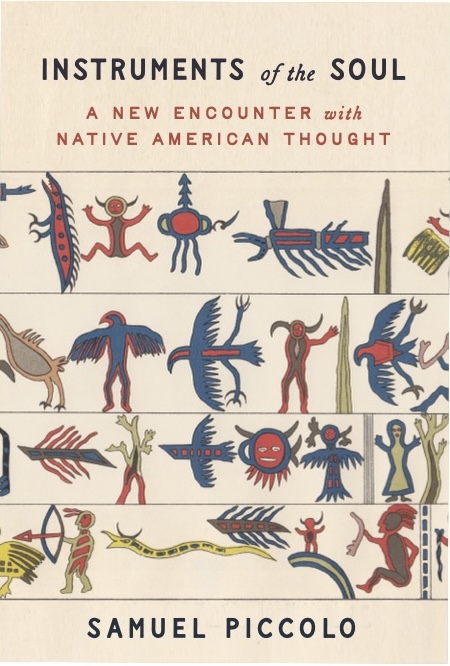
In Instruments of the Soul: A New Encounter with Native American Thought, Samuel Piccolo takes seriously the philosophic traditions and perspectives of Native American peoples for engaging questions of sovereignty, nature, and political legitimacy in the United States and beyond. The book makes the case that contemporary Indigenous accounts of sovereignty and political legitimacy are fundamental claims about the world, not simply reactions to colonial oppression. From this perspective, Piccolo excavates an as-yet-unexplored link between Indigenous political thought and neo-Aristotelian philosophy – finding many surprising, shared understandings of nature, ethics, and politics.
Both traditions maintain a sense of the natural as accessible and intelligible to the human mind, and as ultimately a source of moral knowledge for us. In an age plagued by anxiety, this encounter between Native and Aristotelian thinking suggests to us how we might replace that fearfulness with a more genuine and productive sense of wonder at the world’s meaning.
Endorsements
“My father and I once argued the question: which western philosophical thinker was best positioned for a rigorous dialogue with Indigenous thought traditions? For him, Carl Jung; for me, Walter Benjamin. Our debate is now officially obsolete, for Samuel Piccolo’s Instruments of the Soul makes a brilliant and thorough case for Aristotle, thus placing Native thought in sympathetic relation to the very foundations of western philosophy.”
—Philip J. Deloria, Harvard University
“Instruments of the Soul does an admirable job of showing the parallels between Indigenous and Neo-Aristotelian philosophy – while also clearly defining their features and acknowledging the areas of less overlap. These veins of thinking have the potential to build upon each other and offer a powerful critique of the liberal theory that dominates so much of how many engage with the world today.”
—Keith Richotte Jr., University of Arizona
“This book achieves an ambitious and wide-ranging dialogue by placing brilliant modern Indigenous philosophers in conversation with the ideas of great classical political philosophers. Samuel Piccolo demonstrates that great thinkers from very different perspectives share interests in the same universal issues but different approaches can produce greater wisdom.”
—Kevin Washburn, University of California, Berkeley, School of Law, Assistant Secretary of Indian Affairs at the U.S. Department of the Interior (2012-2016)

